ΠΛΕΩΝ ΕΠΙ ΟΙΝΟΠΑ ΠΟΝΤΟΝ ΕΠ ΑΛΛΟΘΡΟΟΥΣ ΑΝΘΡΩΠΟΥΣ
(while sailing over the wine-dark sea to men of strange speech)
– Homer, Odyssey
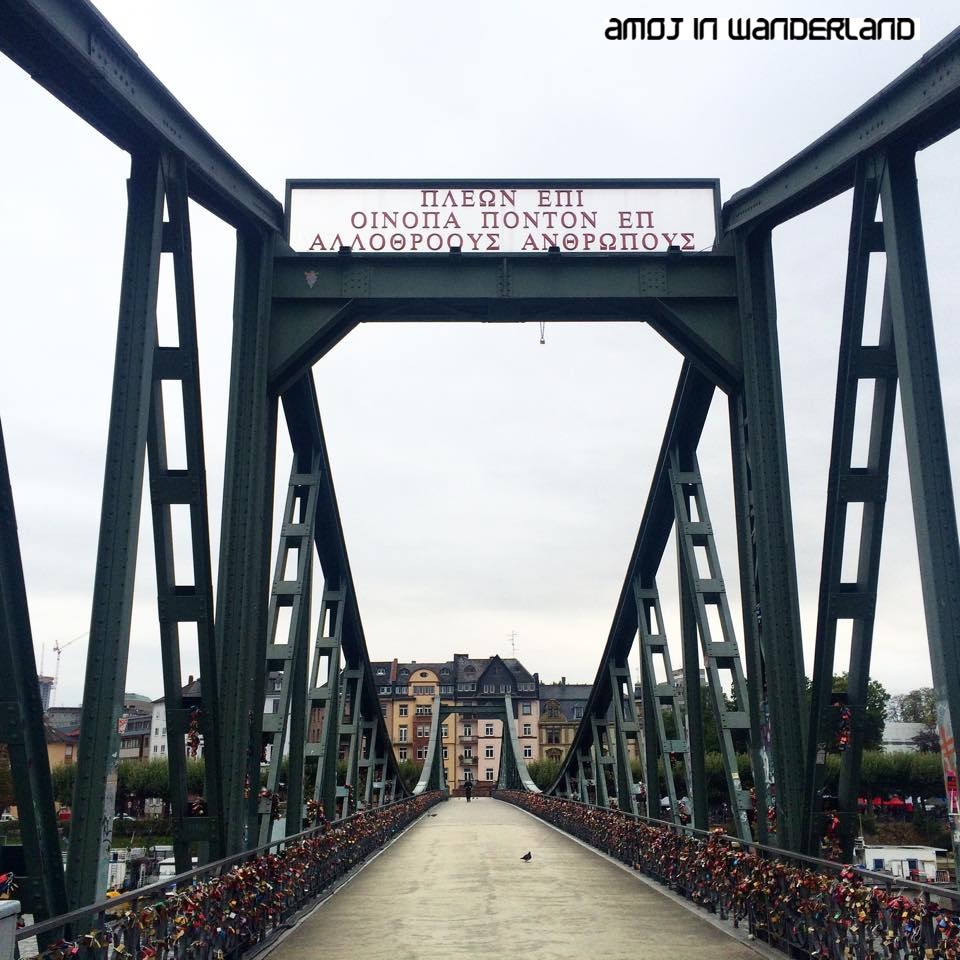
These are the Greek words inscribed at the Eiserneg Steg, the famous iron and concrete footbridge connecting the city center and Römemberg with Sachsenhausen on the southern banks of the Main river. Being used by at least 10,000 pedestrians every day, the Greek phrase which symbolized humanity’s desire to cross the sea and meet with people of different languages suited perfectly with the city’s multicultural society. Forty percent of Frankfurt residents have foreign passports. The footbridge was built in 1868 being the second bridge to cross the river. It was destroyed by the Wehrmacht (German army) after World War II and was rebuilt in 1946.
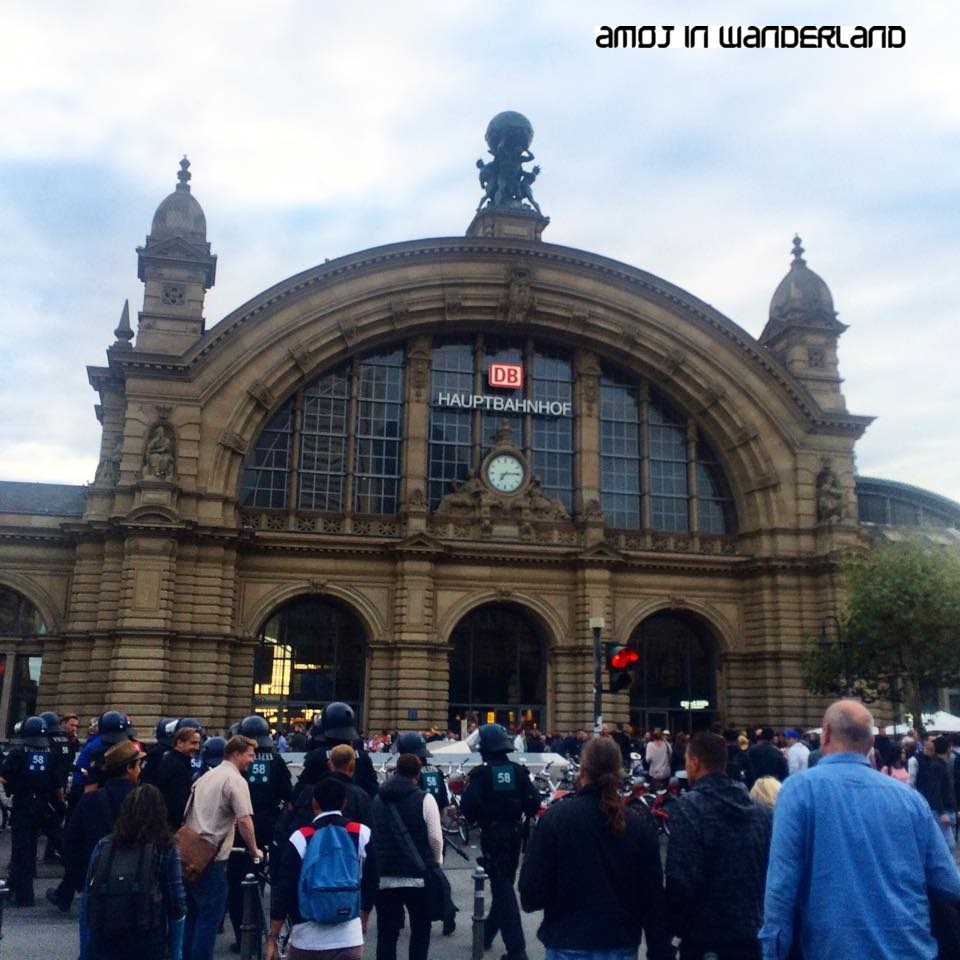
Aside from the famous bridge, I made a tour around Frankfurt’s various landmarks. I arrived the night before with my hotel just a few blocks from the busy Frankfurt Hauptbahnhof (Frankfurt Central Station). The Frankfurt Hauptbahnhof was opened in 1888 to boost the needed capacity for travellers. At the station, there were many people drinking and rejoicing on the streets as Germany won against Poland in UEFA Euro soccer game on that day. I quickly realized that Germany is not a place where you should travel alone, it is indeed a big hang-out place for friends. I didn’t go out much on that night as I was tired of my long flight from Japan. After visiting my relatives near the Schwalbach Limes station, I went to my hotel and slept.
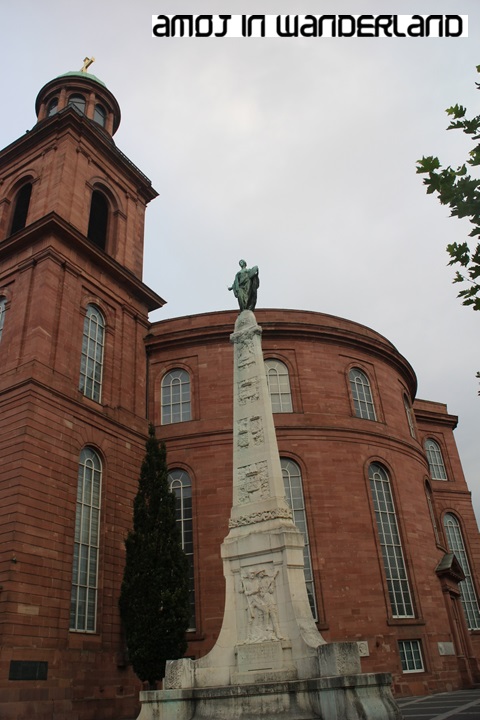
I started my walking tour early the next day since I have to catch my flight to Basel in the afternoon. My first destination was the Römerberg, which is a part of the Alstadt (Old Town). Along the way, I passed the Paulsplatz (St. Paul Square) where the St. Paul’s Church stood. Paulsplatz is the largest square in the old town of Frankfurt am Main which is connected to the south with the Römerberg square. Originally a Lutheran church, Paulskirche (St. Paul’s Church) is an important political symbol in Germany as it became the seat of the Frankfurt Parliament in 1849.
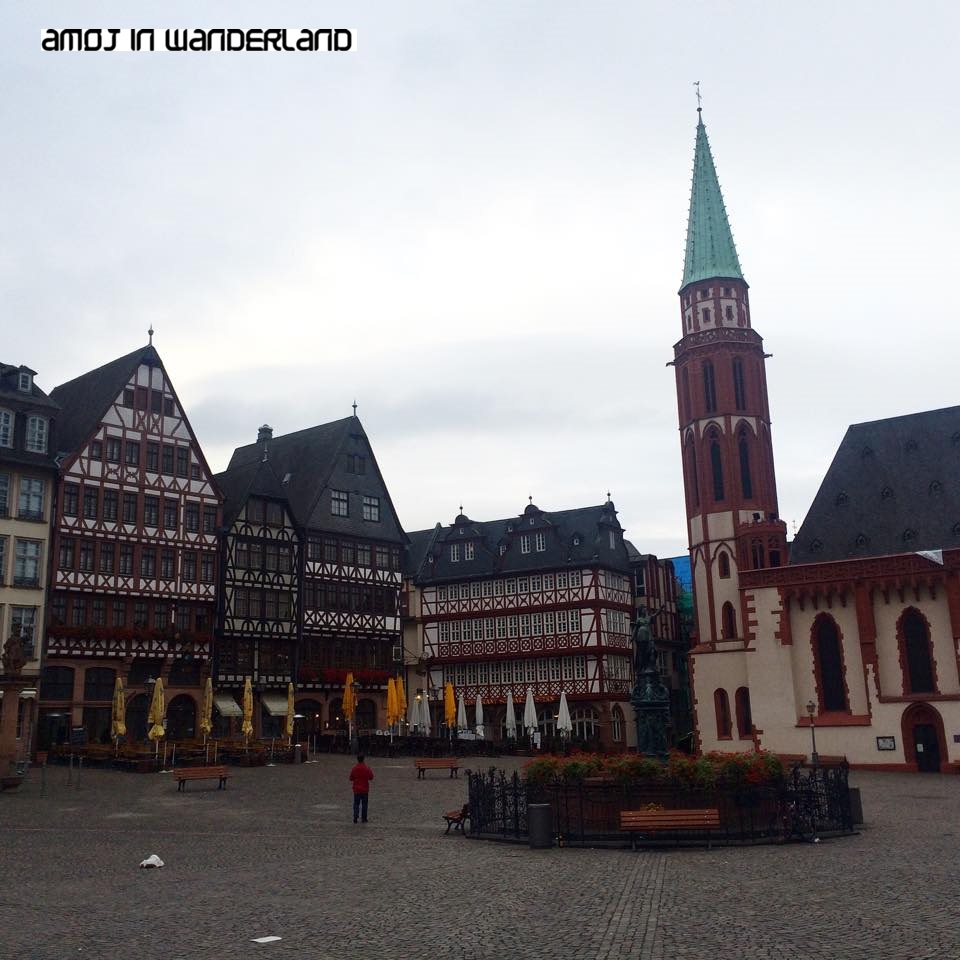
The Römerberg, formerly called Samstagsberg, is an important historical site in Germany as it where the Holy Roman Emperors were crowned. The place has been a Roman settlement during the 1st century, thus having the name “Römer” which is the German word for “Roman”. Large trade fairs were also held in the square for centuries drawing visitors and merchants from other countries. The place is also a site for tournaments, festivals, public executions and imperial elections.
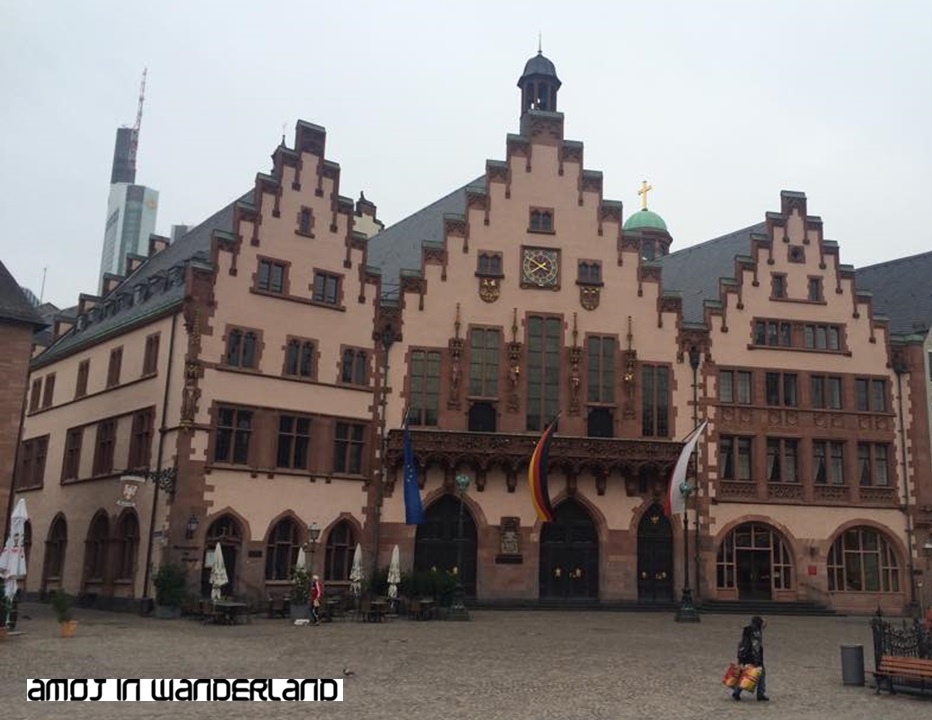
The Römerberg is a complex of nine houses and one church. These houses were bought by the city council from a rich family in 1405. The whole historic district was destroyed during the World War II and the houses were rebuilt according to historical plans. The three middle houses were joined together to form the Frankfurt City Hall (Rathaus). This is where the Kaisersaal (“Emperor’s Hall”) is located where the newly crowned emperors held their banquets.
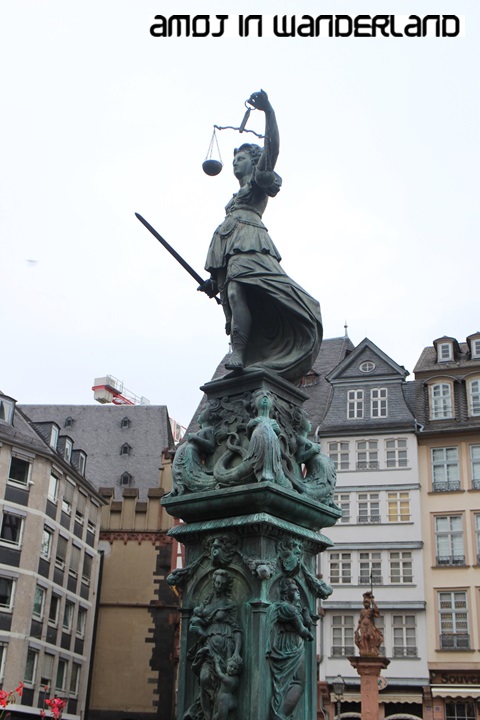
In the center of the square is the fountain of justice (Gerechtigkeitsbrunnen) adorned with the statue of Lady Justice (referring to Justitia, Roman goddess of Justice and Themis, its Greek counterpart). The Gerechtigkeitsbrunnen was built in 1543, being the first fountain in Frankfurt.
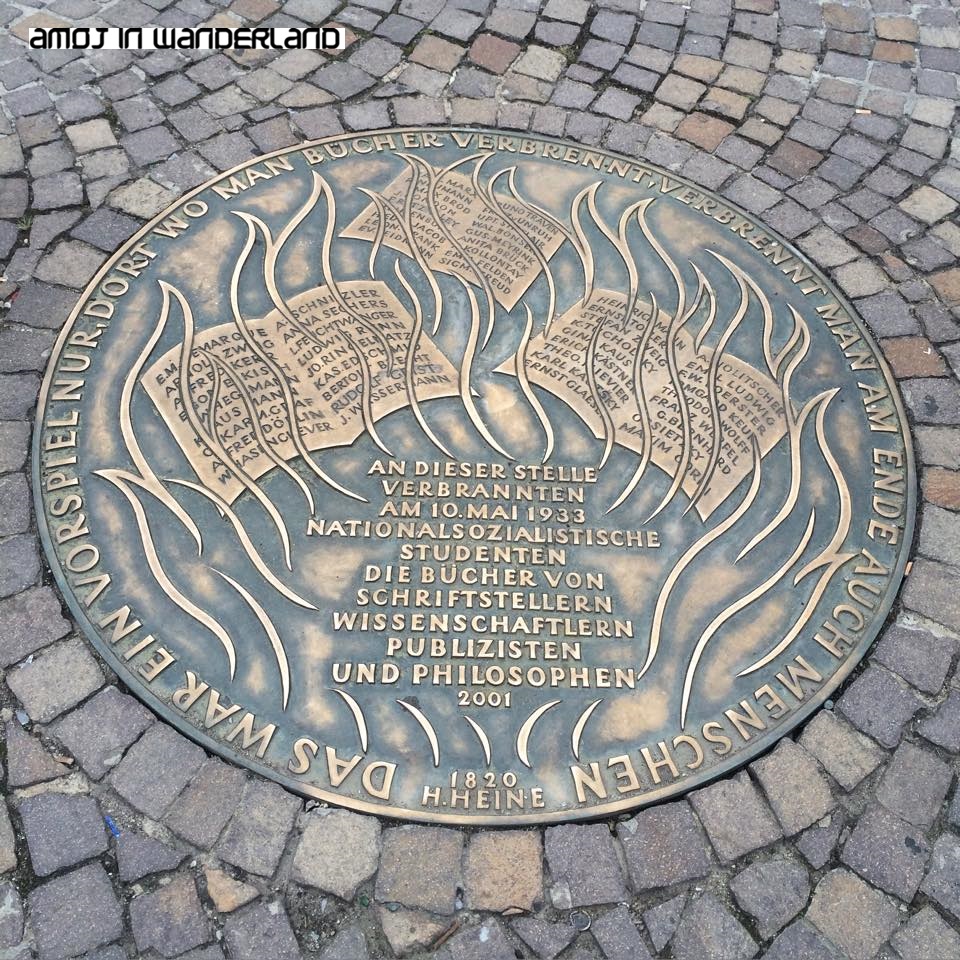
A few steps away from the fountain is a plaque in the cobblestones which serves as the 1933 book burning memorial. This commemorates the Nazi book burning campaign conducted by the National Socialists in the 1930s. This has reminded me of one of the movies I like recently, “The Book Thief”.
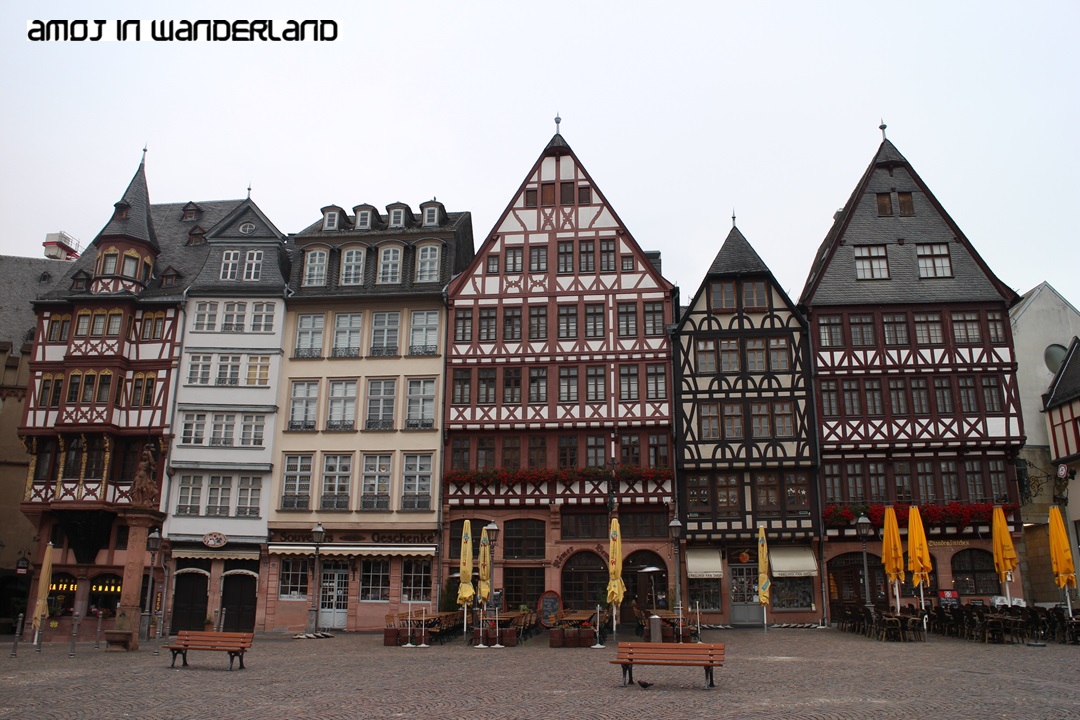
On the east side of the square is a row of framed houses known as Ostzeile. The six picturesque half-timbered houses were named to recall their rich history: Zum Engel (Great Angel), Goldener Greif (Golden Griffin), Wilder Mann (Wild Man), Kleiner Dachsberg-Schlüssel (Small Badger Hill), Großer and Kleiner Laubenberg (Great and Small Laubenberg). Beside the Old Nicholas Church is another house called Schwarzen Stern (Black Star).
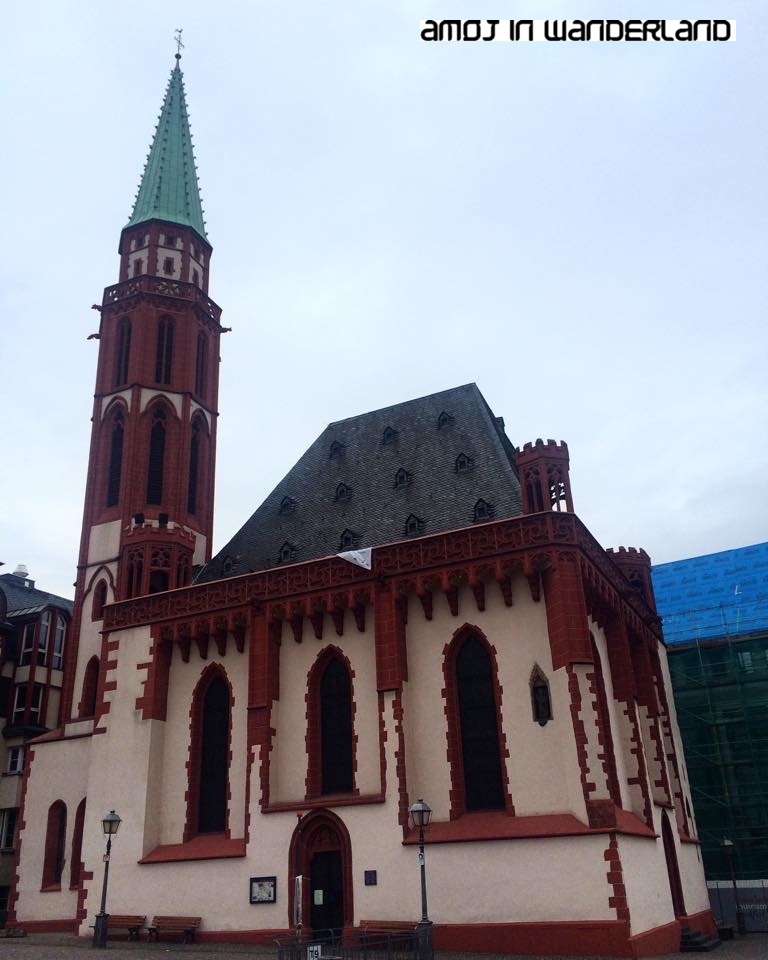
The church in the square known as the Old Nicholas Church (Alte Nikolaikirche) is an early Gothic chuch possibly built in the 11th century. However, it was only been assigned as the official chapel of the city council during the 15th century. A carillon of 35 bells chimes three times a day.
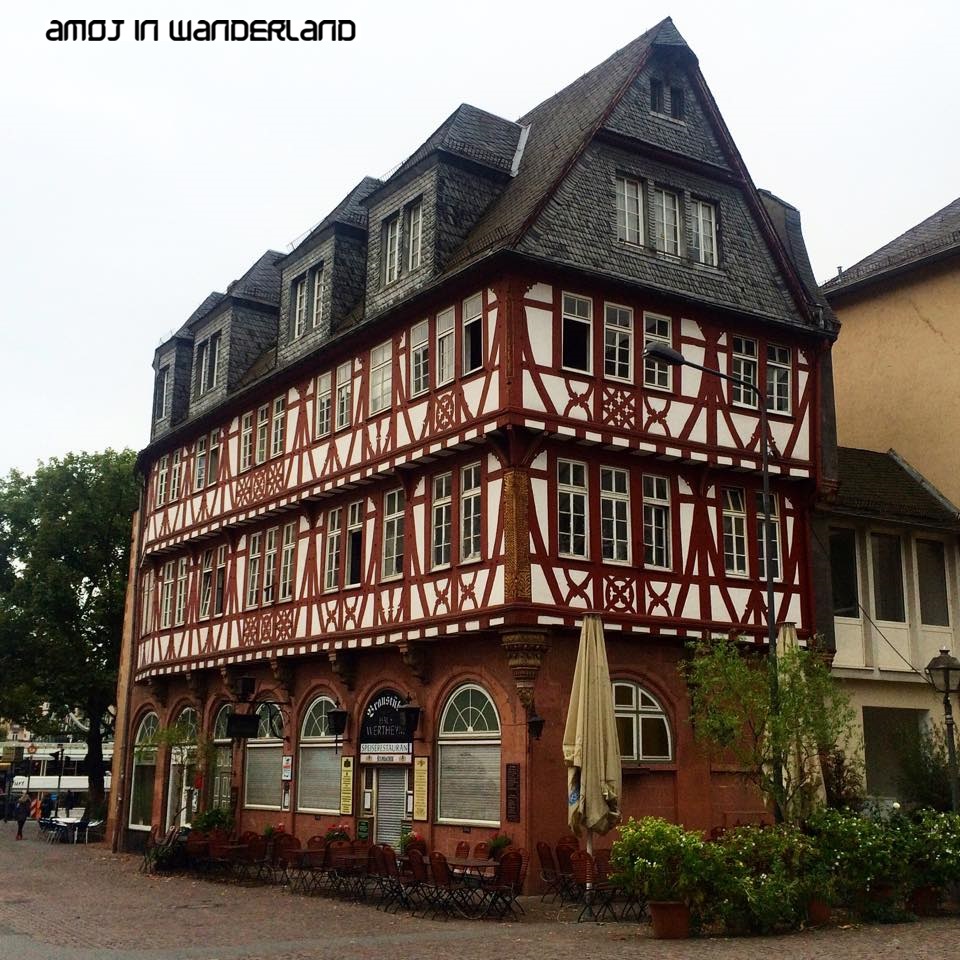
A few steps toward the Main River is the Haus Wertheim. This is just one of the few houses in Alstadt that has survived the 1944 bombardment. It was turned into a restaurant

Few blocks from the Römerberg is the Saint Bartholomew’s Cathedral (Dom Sankt Bartholomäus). The cathedral is a historically important building in Frankfurt as the kings of the Holy Roman Empire were elected here since 1356 and the Roman-German emperors were crowned in the church from 1562 to 1792. The cathedral was destroyed by fire in 1867, rebuilt and partially destroyed in World War II. It was rebuilt in 1950s in its present style with a height of 95 meters.
The next on my list was the Carmelite Cloister famous for the Joerg Ratgeb’s wall paintings. When I arrived there, the building was closed since it was Saturday. So I just continued to my next destination, the Klein Markt Halle (Little Market Hall).
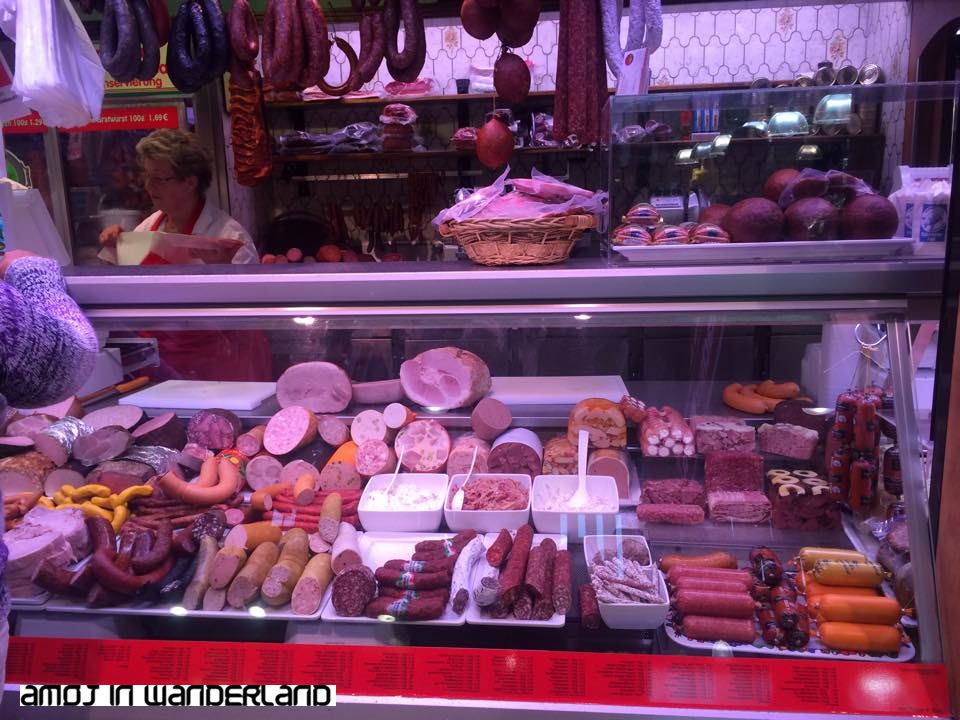
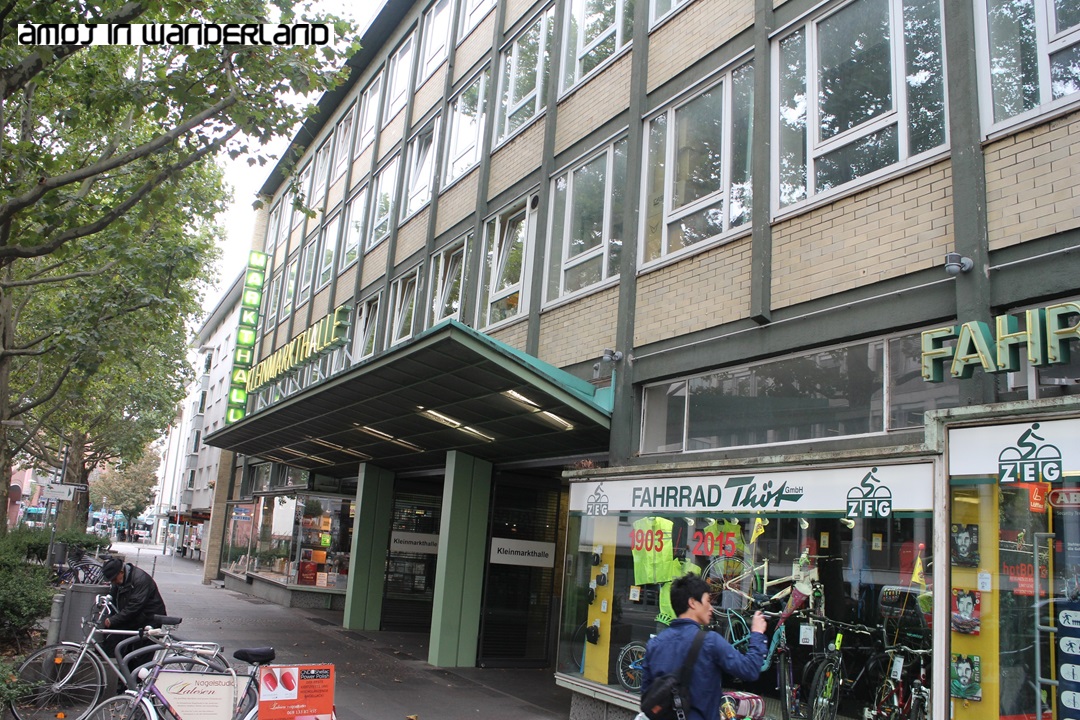
The Klein Markt Halle is a busy and popular indoor market where local and international food products are being sold. It originated when the city built a large place filled with stands selling all sorts of food in the the 1890s. Like the other places I’ve visited in Frankfurt, it was also destroyed during the war and rebuilt to serve as a place to visit and shop in the city.
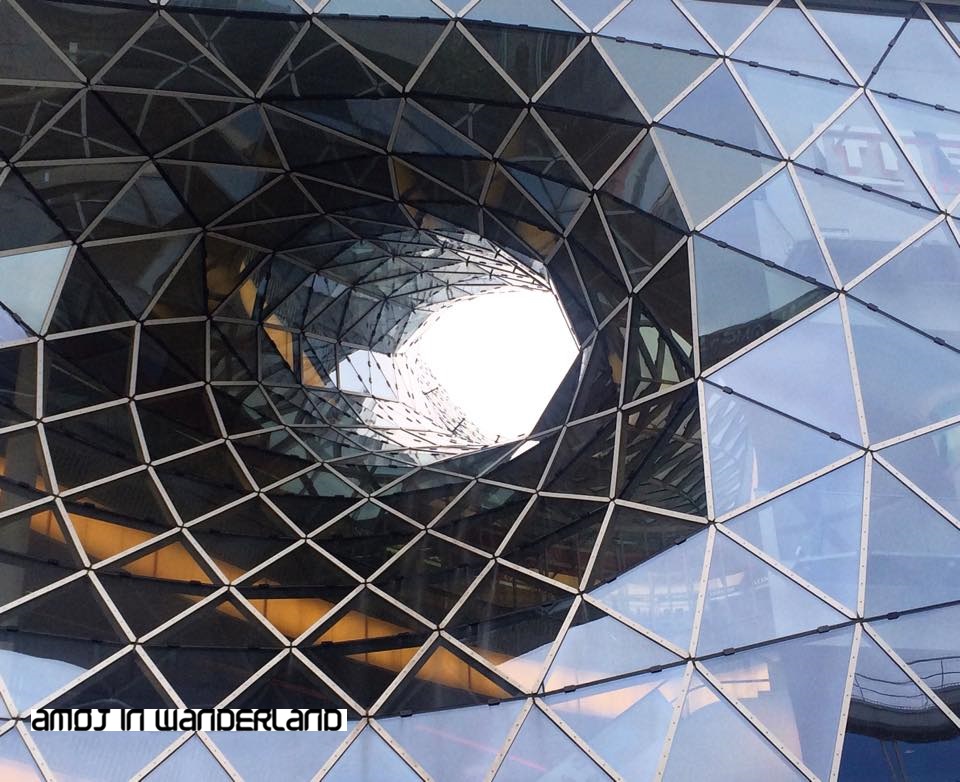
Walking towards my next destination, I passed by a shopping street called Zeil. The name was derived from the German word “zeile” which means row and originally referring to the framed houses in Römerberg. The street was also known before the World war II for its grand buildings. What really caught my attention is the spectacular facade of the shopping arcade MyZeil consisting of 3200 glass triangles and with a big hole that goes through the glass building.
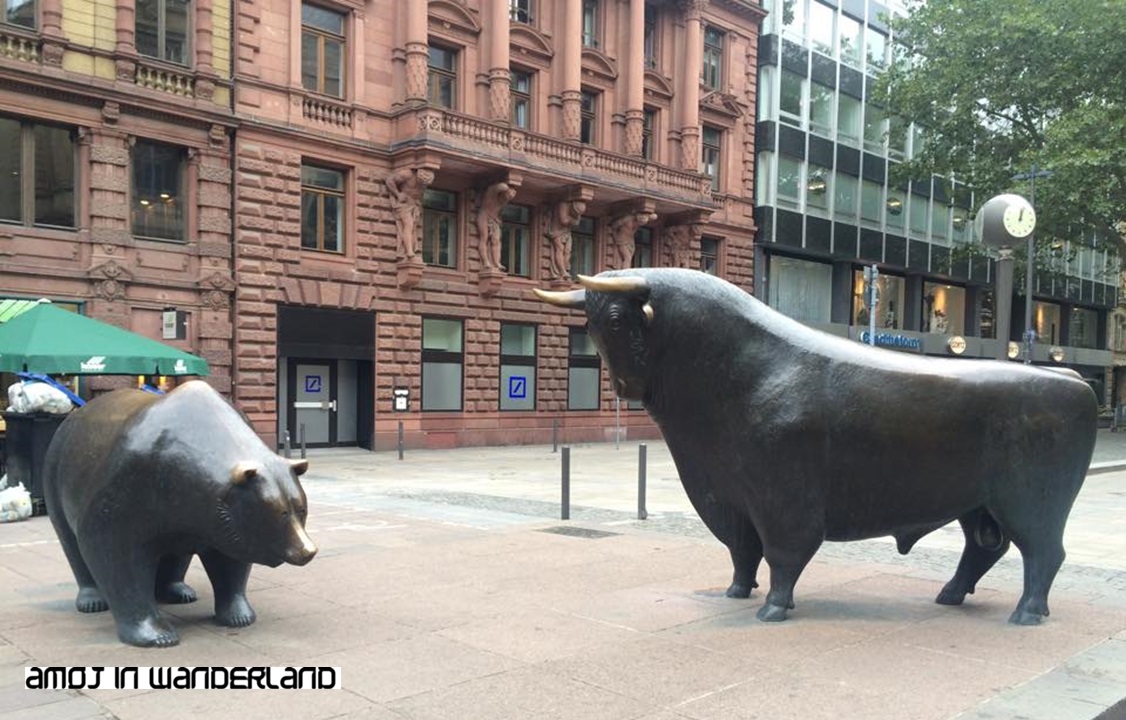
After walking for several minutes, I arrived at the Frankfurt Stock Exchange known as the world’s 10th largest stock exchange by market capitalization. The statues of the two symbolic beasts of finance, the bear and the bull, marks the front of the building. In the stock market world, the terms bull market and bear market describe the upward and downward market trends, respectively.
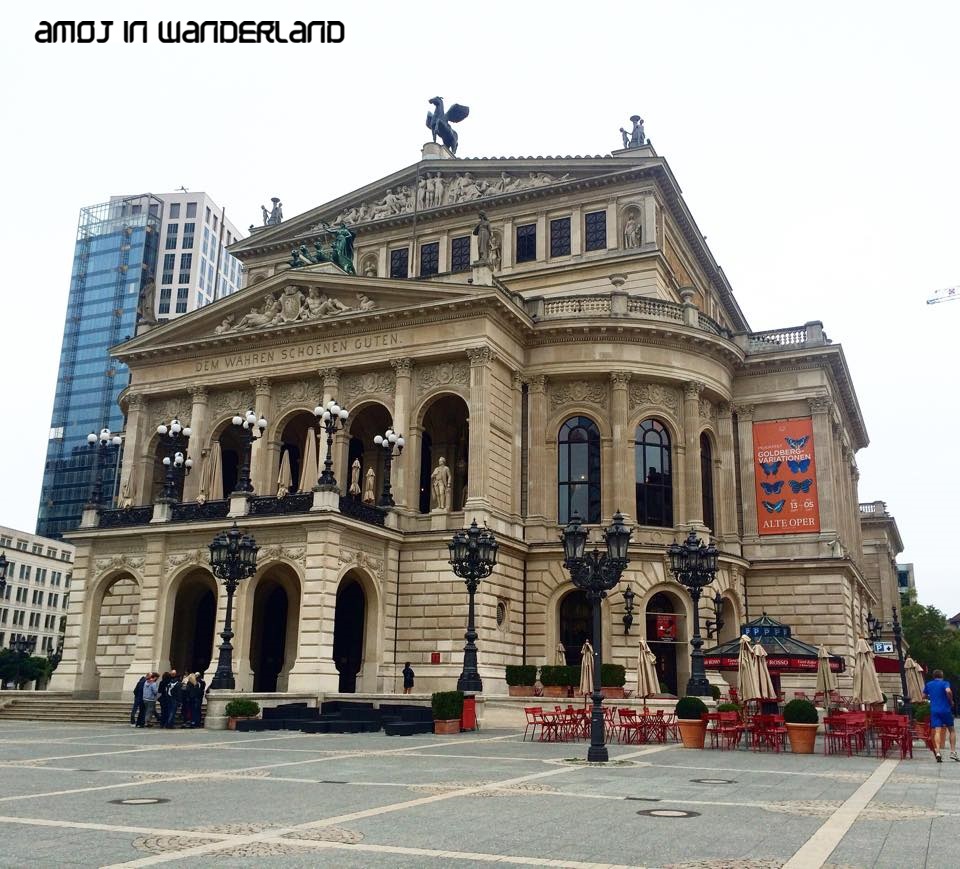
Few hours before my flight, I continued to walk around Frankfurt into the Alte Oper (Old Opera). It was the former opera house built in 1880 and was heavily damaged by the war. Nicknamed “Germany’s Most Beautiful Ruin”, the public demand for its reconstruction and reopening in 1981. Despite a new Frankfurt Opera House was already built, the Alte Oper still functions as a famous concert hall up to this day.
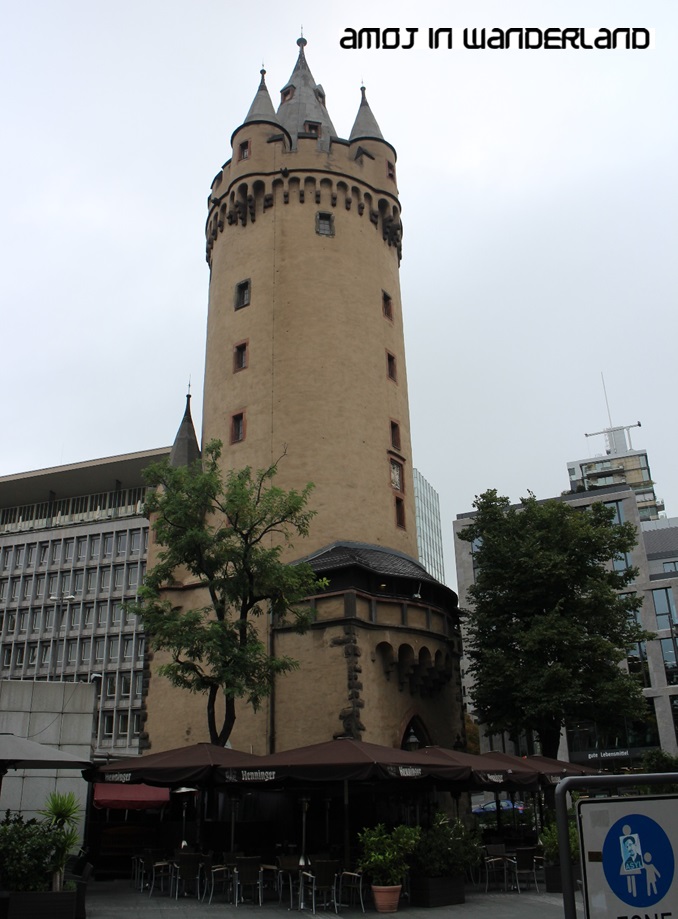
Another medieval age landmark is the Eschenheim Tower (Eschenheimer Turm) being erected at the beginning of the 15th century. It was turned into a bar and restaurant but it still retains as the oldest and most unaltered building in the Innenstadt district of Frankfurt. .
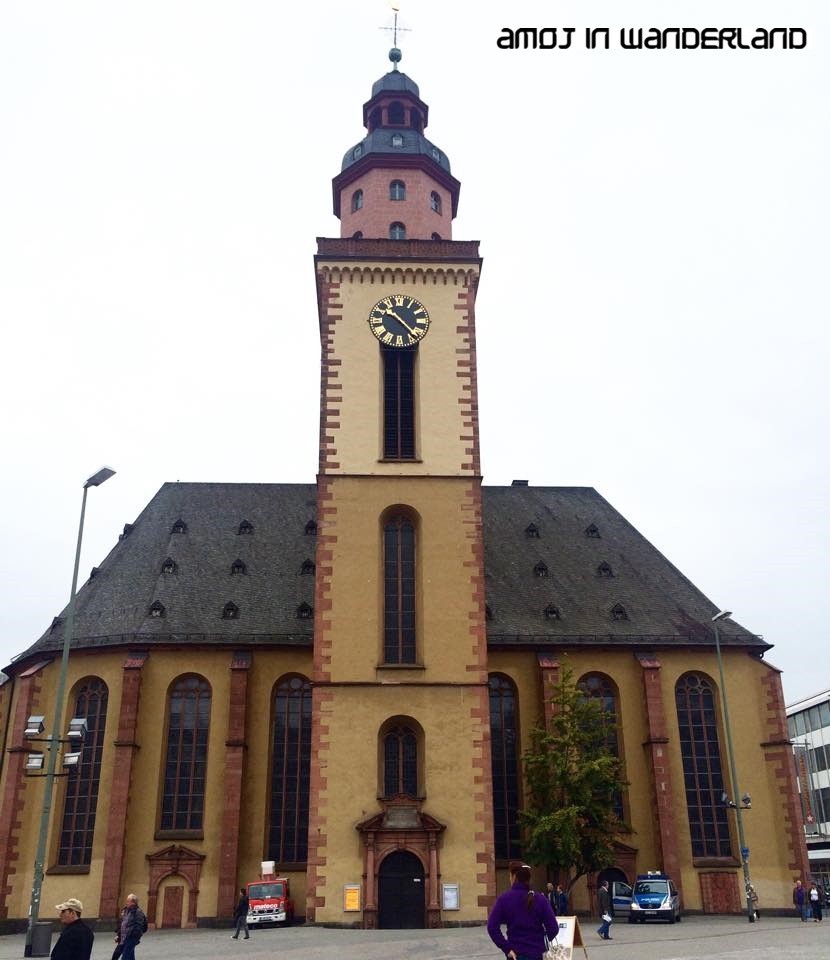
The third and last church on my list is the St. Catherine’s Church (Katharinenkirche). It is the largest evangelical church, dedicated to Saint Catherine of Alexandria.
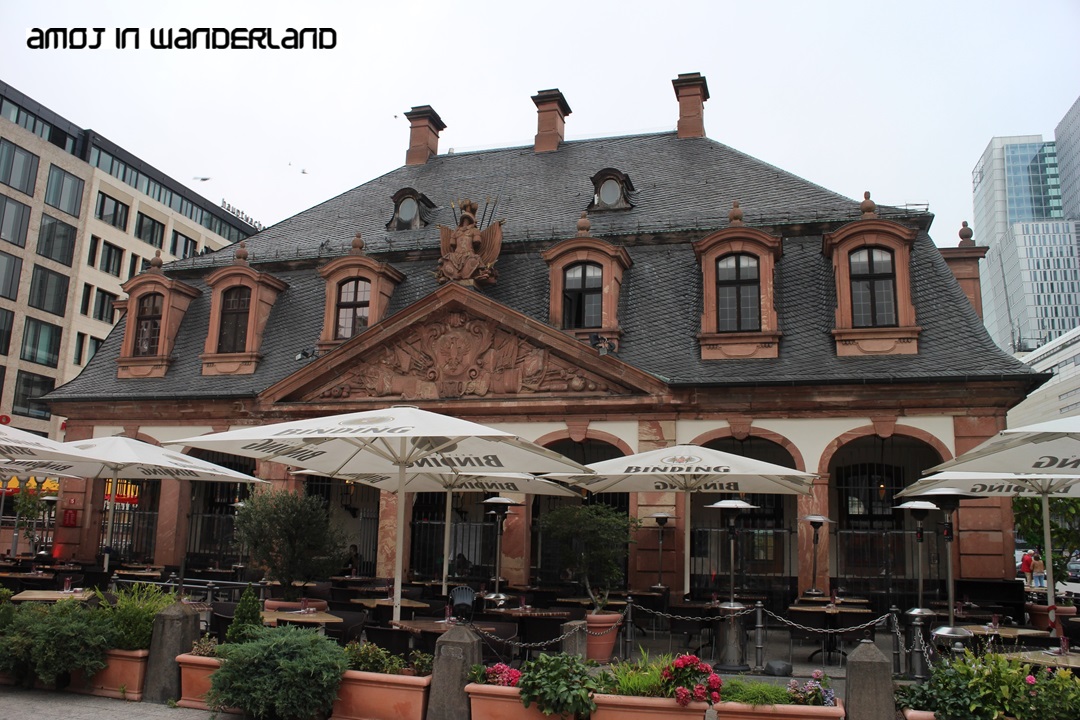
Just opposite the Katharinenkirche is the Hauptwache building. It was built in 1730 as a prison, thus the German name meaning “main guard house”. It is now housing a famous coffee shop in Frankfurt.
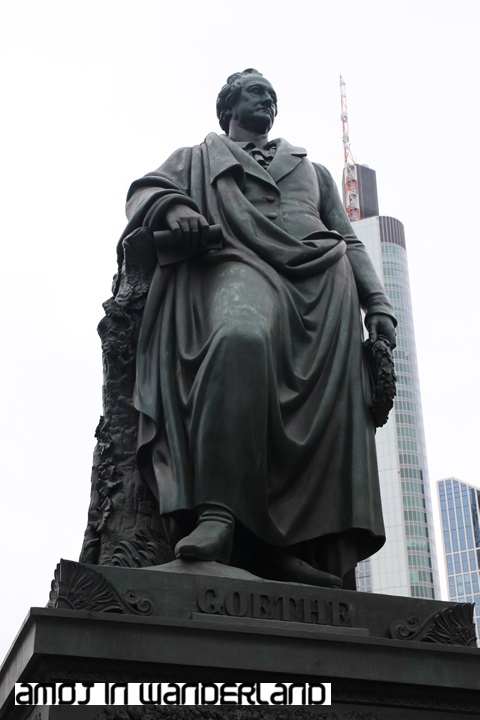
As the most famous Frankfurt-born person, my last stop is the birth house of Johann Wolfgang von Goethe now turned into a museum. I have already talked about the Goethe Haus in my previous blog post. More about the Goethe Haus.
Time checked, It was already 1 PM. I needed to go to the airport and take my flight to my next destination, Basel. Auf wiedersehen, Frankfurt!
 Amoj In Wanderland