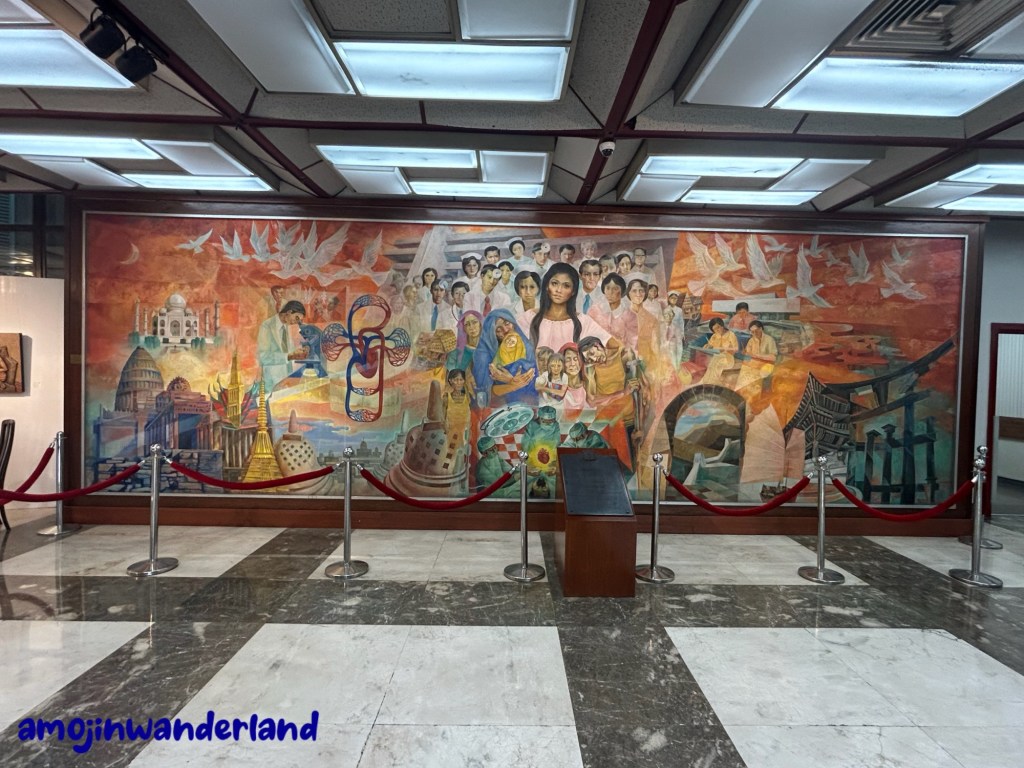
Painted in 1975 by National Artist Vicente Manansala, Inang Bayan is a monumental mural that blurs the lines between art, politics, and propaganda. Installed at the Philippine Heart Center—a premier hospital that was one of many legacy projects of then-First Lady Imelda Marcos—the painting was officially declared an Important Cultural Property by the National Museum of the Philippines on February 28, 2011. At the heart of the mural is a symbolic portrayal of Marcos herself, at the height of her influence during the Marcos dictatorship.
In this idealized composition, Imelda Marcos is depicted as the Ina ng Bayan—the Mother of the Nation—drawing the poor and oppressed to her bosom with outstretched arms. She wears a simple blusa, her hair flowing down in a manner reminiscent of the Virgin Mary, invoking the sacred imagery commonly found in Philippine religious art. This visual sanctification not only elevates her image but also aligns her with a divine, maternal figure—a powerful narrative tool during a time when the regime sought to mask its authoritarianism with symbols of care and compassion.

Yet, this portrayal stands in stark contrast to the reality of the era. While Inang Bayan projects warmth and humility, the Marcos regime was marked by martial law, political repression, and massive corruption. Imelda Marcos, often referred to as the “Steel Butterfly,” became infamous for her extravagance—accumulating hundreds of pairs of designer shoes, commissioning lavish infrastructure projects, and hosting opulent cultural events even as much of the country struggled with poverty. The Philippine Heart Center itself, though a state-of-the-art facility, was one of many institutions built more to project grandeur and soft power than to address systemic health and welfare issues.
Vicente Manansala, who was born in Macabebe, Pampanga and raised in Manila, trained under French Cubist Fernand Léger. His modernist approach—marked by abstraction, geometry, and structure—infused Western techniques with local themes. In Inang Bayan, this style lends formal elegance to an image that, while artistically compelling, serves a deeply political function. It exemplifies how art under authoritarian regimes can be co-opted to construct myths of benevolence and legitimacy.

Inang Bayan remains one of Manansala’s most visually and politically charged works. It stands not only as a testament to the artist’s technical mastery, but also as a complex artifact of a time when visual culture was harnessed to sustain a dictatorship—shaping national identity through a carefully curated image of maternal devotion and power.
 Amoj In Wanderland