
Built in 1637 by the Augustinian friars, Cabuyao, Laguna’s St. Polycarp Church was originally located near the shores of Barangay Marinig. However, persistent flooding in the area eventually led the friars to seek higher ground. In 1763, a major flood destroyed the original structure, prompting a new vision: to build a more permanent and accessible church at the heart of Cabuyao. This new location, closer to the town’s market and government buildings, would later become the site of the present-day Saint Polycarp Parish.
The construction of the new stone church began shortly after the flood, now under the guidance of the Franciscans who had taken over from the Augustinians. It took eight years to complete, finally opening its doors in 1771. The Baroque-style church that now stands is a testament to the enduring faith and architectural skill of that era.
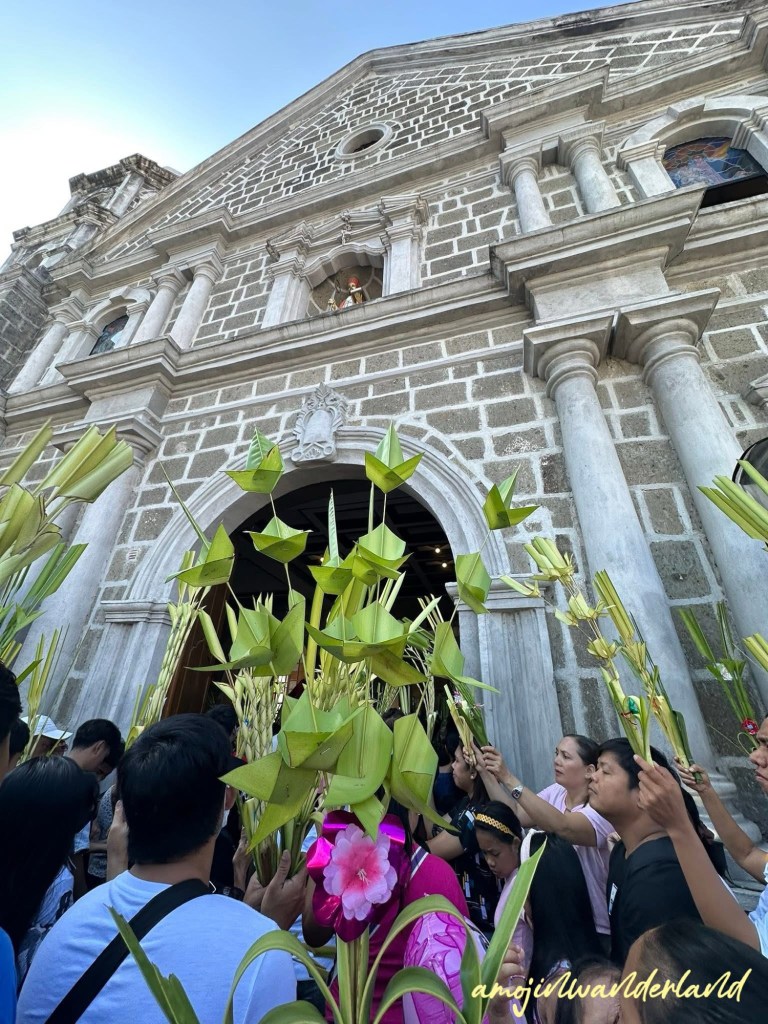
We had the chance to visit St. Polycarp Church on a hot Palm Sunday morning. The sun was intense, and the crowd was overflowing, so we stood outside among the many others who had come to celebrate. Even from the courtyard, the church’s presence was striking—its centuries-old stone façade quietly radiating a sense of solemnity and history.

One of the most tragic episodes in its history occurred on May 3, 1935, during the Sakdalista uprising. Fifty-two members of the Sakdal Movement, a revolutionary group that called for immediate independence from the United States, land reform, lower taxes, and transparent governance, were killed inside the church by constabularies. Founded by Benigno Ramos in 1930, the movement took its name from the Tagalog word sakdal, meaning “to accuse,” a nod to Émile Zola’s J’Accuse…! editorial. That day in 1935, the Sakdalistas had retreated into the church and refused to surrender, prompting a violent crackdown that left dozens dead within its sacred walls.
The church also served as a refuge during World War II, sheltering residents of Cabuyao from the violence and uncertainty of the Japanese Occupation.
 Amoj In Wanderland